|
|||
|
Reliability Tests: Solder Heat Resistance Test (SHRT)
See Also: |
High Temperature Operating Life (HTOL) Test
The
High Temperature Operating Life (HTOL) or
steady-state life test is
performed to determine the reliability of devices under operation at high temperature conditions over an extended period of time. It
consists of subjecting the parts to a specified
bias or electrical
stressing, for a
specified amount of
time, and at a
specified high
temperature
(essentially just a long-term burn-in).
Unlike production burn-in which accelerates early life failures, HTOL
testing is applied to assess the potential operating lifetimes of the
sample population (hence the term 'life test'). It is therefore
more concerned with acceleration of
wear-out
failures. As such,
life
tests
should have
sufficient
durations
to assure that the results are
not
due to early life failures or infant mortality.
The test
duration may be decreased by increasing the ambient temperature for
conditions A to E (refer to Table I, Method 1005). Unless otherwise
specified, all intermediate and end-point electrical tests must be
performed on the parts within
96 hours
(24 hours for Ta>=175 deg C) after their removal from the specified
burn-in conditions. If not specified, an intermediate electrical testing shall be
performed after 168 (+72,-0) hours and after 504 (+168,-0) hours.
Since HTOL is simply long-term
burn-in, it is accomplished by utilizing any
burn-in oven
capable of operating continuously over long durations.
Failure mechanisms
accelerated
by HTOL include Time-Dependent Dielectric Breakdown (TDDB),
electromigration, hot carrier effects, charge effects, mobile ionic
contamination, etc.
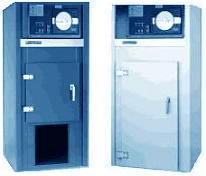
Figure 1.
Examples of Burn-in Ovens
Mil
Std 883, Method 1005 Specs :
-
generally 1000 hours min. at 125 deg C
-
max. rated Tc or Ta < 200 deg C (Class B)
-
max. rated Tc or Ta < 175 deg C (Class S)
-
Condition A : steady-state, reverse bias
-
Condition B : steady-state, forward bias
-
Condition C :
steady-state, power/reverse bias
-
Condition D : steady-state, parallel excitation
-
Condition E :
steady-state, ring oscillator
-
Condition F :
steady-state, temp.-accelerated
Refer
also to JEDEC JESD22-A108.
Other
HTOL Conditions (depending on use) :
-
Ta=125C, 1000H, max Pdis
-
Ta=150C, 500H, max Pdis
-
125C<Tj<150C, 1000H, max Pdis
-
150<Tj<175C, 500H, max Pdis
-
Ta=125C, 1000H, Dyn, max Pdis
-
Ta=150C, 500 H, Dyn, max Pdis
-
125C<Tj<150C, 1000 H, Dyn, max Pdis
-
150<Tj<175C, 500 H, Dyn, max Pdis
-
Ta=125C, 120H, max Pdis
Copyright
©
2001-2005
www.SemiconFarEast.com.
All Rights Reserved. |
||